
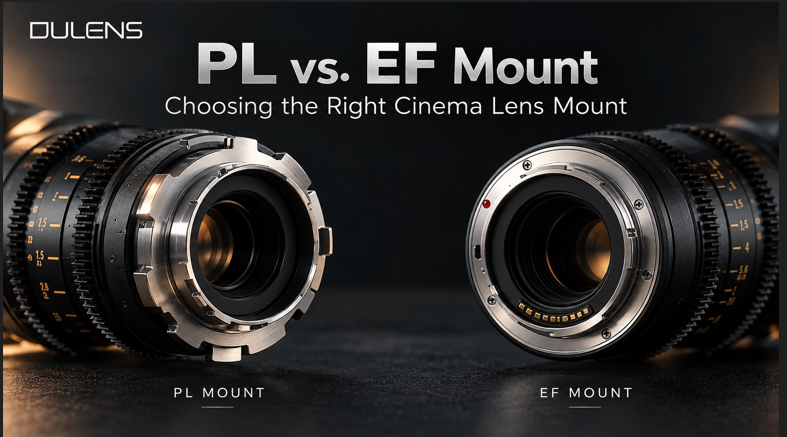
Your new camera body just arrived, and now the real decision sits in front of you. Do you use EF glass because it is easily accessible to you? Or do you go for PL lenses because your gaffer keeps talking about them on set? This decision will affect your budget, your workflow, and how your footage compares to your competition.
Most online guides only provide mount specs, and that’s it. The slightest difference in mounting and workflow can slow down a hectic shooting day. Renting the wrong glass twice in one month gets expensive fast. Choosing the mount too early can also limit future camera upgrades.
There is a wide range of rental house pricing for PL and EF equipment within a single production. This depends on factors like sensor coverage, adapter options, and the overall price of the lens. All of these are explained in detail later in this guide. For many crews, it is not uncommon to change mounts partway through their careers when their budgets and projects expand. Understanding both systems now saves you from a costly mistake later.
But what really changes when you move from EF to PL? And why are compact PL mount prime sets now a good fit for many film crews?
This guide explains both mounts in clear, simple terms. It covers flange size, lens fit, adapters, sensor size, and key lens options. By the end, you will have a clear view of which mount may fit your next shoot best.
What Is a PL Mount, and Why Does It Matter?
ARRI introduced the PL mount , or Positive Lock, in 1982. It uses a four-point locking ring instead of a basic spring-loaded bayonet. The ring holds the lens firmly in place.
This design helps keep heavy cine lenses from moving during a shoot. Cinema lenses can weigh much more than photo lenses with the same focal length. Even a small amount of movement can affect the image during a focus pull.
The PL mount has a flange focal distance of 52 mm. Many leading cinema lens brands use this same standard, including Zeiss, Cooke, Angenieux, and Dulens. This common standard also makes PL lenses easy to find at many rental houses.
Many modern PL lenses also have a data link. It can send focus, iris, and zoom data to the camera or other gear. The lens itself is still manual, so the focus and iris are set by hand.
What Is an EF Mount, and Where Does It Fit?
Canon launched the EF mount in 1987 for its still photography cameras. It relies on electronic contacts paired with a leaf-spring bayonet lock. The mount also supports autofocus motors built directly into the lens body.
The EF mount uses a flange focal distance of 44 mm, noticeably shorter than PL. This shorter flange focal distance is one reason EF lenses cannot simply adapt onto PL camera bodies.
Independent filmmakers still favor EF mount because Canon glass is everywhere. You can find EF lenses at nearly any camera store, often at prices that fit tighter budgets. Several Canon Cinema EOS bodies ship with EF mounts as their standard fit.
Many cinema camera brands beyond Canon also offer EF mount versions. Blackmagic, RED, and Sony have all shipped EF-mount camera bodies over the years. That wide adoption keeps EF glass relevant well past its still photography roots.
Autofocus and Manual Focus in Cinema Work
Most pro film shoots still use manual focus. A competent focus puller can move the camera and maintain a sharp focus on the subject for the duration of the shot.
EF mount supports autofocus with built-in lens motors. This can help solo shooters and small film crews who do not have a focus puller. PL mount does not offer auto focus. It has lenses that are designed for full manual control.
That’s one of the reasons you’ll notice the difference between PL lenses on set. They have a steady motion of their rings. The long focus throw also makes it easier to set and repeat focus marks.
A small PL mount prime set retains the smooth manual operation of the camera while reducing the weight of the lens. It provides crews control while providing minimal bulk in the camera rig.
Autofocus still has real value on smaller crews without a dedicated focus puller. It saves time for interviews, events, and run-and-gun situations. EF lenses are better suited for solo shooters who prioritize speed over manual control.
PL vs EF: Key Differences at a Glance
The table below lays out differences most production teams care about before committing to a lens system.
| Feature | PL Mount | EF Mount |
| Flange focal distance | 52 mm | 44 mm |
| Locking method | Four-point friction ring | Leaf spring bayonet |
| Focus type | Fully manual | Manual or autofocus |
| Weight tolerance | Built for heavy primes and zooms | Suited to lighter stills glass |
| Lens cost range | Higher, professional cine pricing | Lower, wider budget range |
| Typical users | Feature films, commercials, episodic TV | Documentaries, small crews, indie work |
Why Flange Focal Distance Decides Compatibility
Flange focal distance is the gap between the lens mount and the camera sensor. This gap must be exact for the lens to focus and form a sharp image.
A lens with a shorter flange distance can often fit a camera with a longer one by using the right adapter. This is why some PL lenses can work on EF cameras with a good adapter.
The reverse is much harder. EF lenses have a shorter flange distance than PL. So, there is not enough space to place an EF lens at the right spot on a PL camera.
Camera makers also tend to keep the same flange distance once a mount is in use. This makes the mount a key factor when crews plan their lens kits and future camera upgrades.
Some cinema cameras have an even shorter flange distance than EF. The ARRI Alexa Mini, for example, has a flange depth of about 39.5 mm behind its PL mount. This gives the camera more room for parts such as filters and cover glass.
PL to EF and EF to PL Adapters: What Actually Works
Adapters can help you use some lenses on a different mount. But they do not work for every lens and camera pair. Always check the flange focal distance before you buy an adapter.
PL lenses can often work on EF camera bodies with the right adapter. PL has a 52 mm flange distance, while EF has a 44 mm distance. This leaves an 8 mm gap for the adapter to fit.
Still, not every PL lens will work. Some lenses have rear parts that sit too close to the mount. This can cause fit or clearance issues. Adapter makers such as FotodioX list lens models that work with their adapters, so check the list before you buy.
EF lenses cannot be adapted to PL camera bodies in the same way. Their flange distance is shorter than the PL standard. There is not enough space to place an EF lens at the right point behind a PL mount.
This is worth keeping in mind when you buy a new camera. A PL body can give you more lens options, including some EF lenses with the right adapter. An EF-only body, on the other hand, does not give you access to native PL lenses.
Build Quality and On-Set Reliability
A PL mount holds a lens firmly with very little movement. This stays true even after months of heavy use. Focus pullers need this steady fit because their focus marks must stay right from one shot to the next.
EF mounts were first made for still photos. In that type of work, a small amount of movement may not cause a big issue. On a moving film set, though, even a small shift can show up in the image during a fast focus pull.
That does not mean EF is a bad choice for every crew. Many documentary and run-and-gun shoots do not push the lens hard enough to see much of a gap. The difference is clearer on high-end shoots where a focus puller works with the camera team.
A compact PL mount prime set can also help smaller crews. It keeps the firm PL lock while using less weight. This makes the lens set easier to use on light camera rigs, gimbals, and other small setups.
Lens Options and Total Cost
EF mount has a clear edge when it comes to lens choice. Canon has made EF lenses for many years, and many other brands also make EF glass. Used EF lenses can also be a good fit for small teams with a tight budget.
PL lenses tend to cost more to buy and rent. They are made for film work, with strong metal bodies and tight build specs. Many PL lens sets also use the same gear layout across the range. This helps the crew work with the same setup from one lens to the next.
New PL lens brands have also made the gap in price much smaller. Today, you can find a compact PL mount prime set at a much lower cost than many older PL sets. This can make PL a fairer choice for small and mid-size crews.
Rental costs also tend to be higher for PL sets. A full PL prime set may cost a few hundred dollars per week. EF sets are often cheaper, which can help crews that need to keep each shoot within a set budget.
Sensor Coverage: Super 35 Versus Full Frame
Your lens mount and sensor size both matter when you pick a lens. Most cinema lenses show the size of the image area they can cover.
Super 35 lenses cover a smaller image area of about 31.5 mm. Full-frame and VistaVision lenses cover a much larger area, close to 46.5 mm.
Both PL and EF lenses are made for Super 35 and full-frame cameras. A full-frame compact PL mount prime set can also work on a Super 35 camera. You will not lose part of the image because the lens is too small for the sensor.
The reverse does not work. A Super 35 lens may not cover a full-frame sensor. This can leave dark areas around the edge of the frame. So, check your camera’s sensor size before you pick a lens set.
A full-frame compact PL mount prime set can give you more room to grow. If you move to a larger sensor camera later, you may not need to replace the whole lens set.
Why Compact PL Mount Prime Sets Are Gaining Ground
Old PL prime lenses were often big and heavy. They were made for large film cameras that needed strong rig support. For small crews with light camera rigs, this extra weight could be hard to manage.
A compact PL mount prime set offers a more practical option. It keeps the firm PL mount and key cine features but cuts down on size and weight.
This makes PL lenses easier to use on small camera rigs. Crews can also use a compact PL mount prime set on a gimbal without adding too much weight. Focus pullers still get the smooth focus feel they need for precise shots.
A good compact PL mount prime set can offer these useful features:
- Uniform front diameters across every focal length in the set
- Matched color rendering and contrast from lens to lens
- Standard 0.8 MOD gearing for follow-focus compatibility
- Lightweight metal housings suited to drones and gimbals
- Interchangeable PL and EF mounts on select lens lines
The last point can be key for crews that plan to grow. A compact PL mount prime set with PL and EF mount options can work with more than one camera setup. This can help protect your lens spend as your gear changes over time.
The weight gap can also add up across a full set. A five- or six-lens kit can be much easier to carry when each lens is light. Some older PL primes can weigh close to 2 kg each, while a compact PL mount prime set may cut that weight by close to half.
Popular Lens Options by Mount
Knowing lens names makes it easier to compare rental lists and buying guides. Each mount has a set of well-known lenses used by film crews.
For PL mounts, popular options include the Zeiss Supreme Prime and ARRI Signature Prime lines. Cooke also makes the S4/i and S7/i lens sets for PL cameras. A compact PL mount prime set from a newer brand can cost much less than these well-known lines.
For EF mounts, Canon offers CN-E cinema primes made for Cinema EOS cameras. Sigma also has a Cine FF prime range in EF mount. Rokinon and Samyang offer more budget-friendly EF cine lenses for smaller crews.
Some brands now make lenses with mounts that can be changed. This lets one lens work with both PL and EF cameras. DZOFILM and Dulens are examples of brands that offer PL, EF, or both mount options.
When you compare lenses, do not look at the mount name alone. Check the lens build, weight, gear setup, and mount options too. A compact PL mount prime set from a newer brand may offer strong image quality while also being lighter and easier to use.
Choosing by Production Type
Documentary crews often need speed and ease of use. EF mount can be useful here, as it assists with autofocus during fast-moving shots and in action interviews.
Commercial shoots often have a tight time plan and a focus puller on set. In situations where focus marks need to be held in perfect alignment, PL mount may be more suitable.
Narrative films and TV shows often use PL mount as the main choice. PL is a common option for these jobs, as it is tailored to meet the needs of the crew, rental stock, and camera team rules.
There are two options with which small indie films can fit in between. With a compact PL mount prime set, you can achieve a film look without the price tag of a big crew. With just two people, you can obtain clean, sharp images using the right equipment.
For many small shoots, a simple PL mount prime lens rig and a basic follow focus system may suffice.
Which Mount Should You Choose for Your Shoot?
The right lens mount often starts with your camera. Check which mount it uses and its flange focal distance before you pick your lenses.
For ads, TV shows, and films with a full crew, PL mount is often a good fit. Focus pullers are used to PL lenses, and the mount gives them a solid setup for precise focus work.
For small crews and documentary work, EF mount can be a more practical choice. There are many EF lenses to choose from, including used options that can help keep the cost down.
You can also keep both mounts in your kit. A compact PL mount prime could be suitable for film shooting or ads, and EF zoom lenses might be useful if you need speed. Finally, consider your camera, crew, shoot type and budget before making your decision.
Final Thoughts
The decision of PL vs. EF mount will depend on how your shoot is actually performed day-in, day-out. Match the mount to your crew size, your budget, and your existing camera body.
If your work is moving toward higher-level commercial or narrative work, act now. Today, that means investing in a compact PL mount prime set. It provides your team with space to expand without having to replace the glass each year.
Dulens Optical manufactures exactly this type of lens set for working crews. Our compact PL mount prime sets combine true cine-grade precision with the lightweight housing modern productions need. Every lens shares consistent color science, matched gearing, and interchangeable PL and EF mounts. Your kit grows alongside your camera lineup instead of holding you back.
Talk to the Dulens Optical team and build the compact PL mount prime set your production deserves.
FAQs
Can you mount EF lenses on a PL camera?
No. EF lenses have a shorter flange distance than PL lenses. This makes a standard EF-to-PL adapter essentially impossible to use.
Can PL lenses be adapted to an EF mount?
Yes, some PL lenses can be used on EF cameras with the right adapter. But this does not work with every PL lens, so check the lens and adapter before use.
Is PL mount better than EF mount for filmmaking?
PL mount provides better build quality and more lens stability. EF mount offers lower cost and wider lens availability.
Why are PL mount lenses more expensive than EF lenses?
PL cine lenses often use strong metal bodies, tight build tolerances, and standard cine gearing. These features add to the cost of making the lens.
What is a compact PL mount prime set?
A compact PL mount prime set includes several small and light cinema lenses. It gives you the PL mount in a more portable design. This makes the lenses a good fit for gimbals, drones, and small camera setups.
Do PL lenses cover full-frame cameras?
It depends on the lens. Some PL lenses are made to cover full-frame sensors, while others work with smaller sensor sizes. Check the lens image circle to know if it will cover your camera’s sensor.
Can I use a PL-to-EF adapter on any lens?
Not always. Some PL lenses may not fit or work well with a PL-to-EF adapter. Before you buy one, check the lens specs and the adapter’s supported lens list.