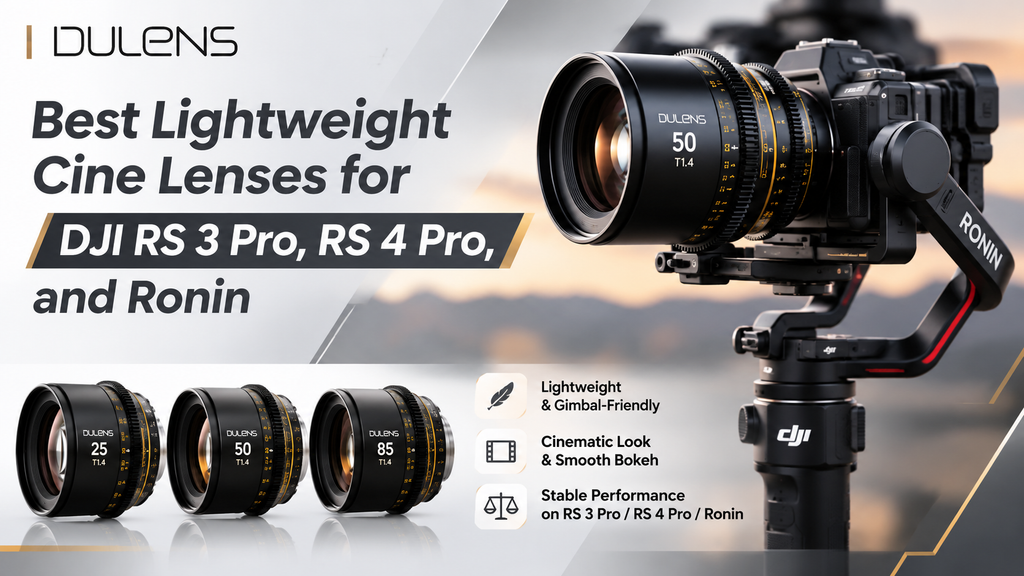
A cinematic shot can lose its impact when the camera rig gets too heavy. This is a common problem for filmmakers who use motorized gimbals. Balancing is more difficult, and camera motion is restricted with large lenses. They also add more weight to an already heavy setup.
The DJI RS 3 Pro and RS 4 Pro can handle professional camera setups. Easy balancing doesn’t always mean staying within the payload limit. The camera body, lens size, cage, and focus system all play a part. Small changes have a big impact on the overall rig balance.
This is where lightweight cine lenses can help. They provide essential elements in cinema in a light and easy way. They also allow for quick and easy transitions between gimbal, handheld, and tripod modes. This can save time and ease crew work.
Still, weight should not be the only thing you look at. Before purchasing, verify lens coverage, aperture, mount, and gear position. For multi-camera shooting, color and image quality must match up fairly well. A budget multi-cam cine lens should be both quality-driven and long-lasting.
In this guide, we look at some useful cine lens options for DJI Ronin users. You will see the main features, weight, and how they are used during real shoots. We will also discuss the primary factors to consider before purchasing so that you can pick a lens that suits your camera and shooting style.
What Makes a Cine Lens Suitable for DJI Ronin Gimbals?
The ideal cine lens for a gimbal should be light, compact and simple to use. It also needs to provide ample space for other camera equipment while not getting too heavy on the case. A quality lens can help to balance and save time during setup.
Here are a few key features to look for before buying:
Lightweight build: A lighter lens leaves more room for other camera gear and accessories.
Compact size: A short lens barrel makes it easier to position the camera and balance the gimbal.
Matching gear positions: Similar focus and iris gear positions make lens changes quicker.
Consistent colour: Matching colour tones help keep shots looking alike across multiple cameras.
Wide aperture: A fast aperture lets in more light, which helps when shooting in low-light settings.
Right lens mount: Check if the lens fits your camera or needs a mount adapter.
All of these features can be incredibly useful on set. They save time for small crews and fewer delays for larger crews between shots.
Best Lightweight Cine Lenses for DJI RS 3 Pro, RS 4 Pro, and Ronin
Several cine lens ranges offer useful features for gimbal-based productions. However, their weight, sensor coverage, and handling needs can differ. The following options cover different budgets and production requirements.
1. Dulens APO Mini Prime
Best for: Lightweight full-frame cinema setups
The Dulens APO Mini Prime series is a good option for compact cinema rigs. It has a small build and gives footage a mix of modern and vintage looks. The series comes in 21mm, 31mm, 43mm, 58mm, 85mm, and 110mm focal lengths.
Most lenses in the range weigh between 500 and 540 grams. This makes them easy to use for handheld and gimbal shoots. Their maximum aperture ranges from T2.4 to T2.6, based on the focal length.
The lenses share an 80mm front diameter, which makes it easier to use the same accessories across the range. They are also available in PL and EF mounts for compatible cinema cameras. Their matched design helps crews switch between focal lengths with fewer setup changes.
For teams looking for a budget multi-cam cine lens, the Dulens APO Mini Prime series is worth a look. Its compact build and full-frame coverage make it useful for different types of shoots. The vintage-style image also adds a distinct look to the footage.
2. SIRUI Night Walker T1.2 S35
Best for: Low-light shooting and compact Super 35 cameras
The SIRUI Night Walker series is known for its fast T1.2 aperture. It comes in 16mm, 24mm, 35mm, 55mm, and 75mm focal lengths. These lenses are made for APS-C and Super 35 camera formats.
Most models weigh around 585 to 601 grams, based on the mount. They also have a 270-degree focus rotation and a 67mm filter thread. The matching gear positions make it easier for crews to switch lenses during a shoot.
The Night Walker series works well for compact gimbal setups. Its fast aperture also helps when shooting in low light. However, these lenses offer Super 35 coverage, so they may not be the right fit for every full-frame camera.
3. DZOFILM Vespid Prime
Best for: Professional productions needing full-frame coverage
The DZOFILM Vespid Prime series offers a wide range of focal lengths. These include 12mm, 16mm, 21mm, 25mm, 35mm, and several longer options. The series also supports full-frame and Vista Vision coverage.
Its compact metal body makes it suitable for handheld and gimbal shoots. The lenses are available in PL and EF mounts. They also feature standard 0.8 MOD gears, which work with common cinema focus systems.
Weight varies by focal length, from around 725 to 1,021 grams. This makes the Vespid Prime series heavier than many compact cine lenses. So, crews should check the weight and balance of their full camera setup before using these lenses on a gimbal.
4. Meike Full Frame Prime Cine Lenses
Best for: Full-frame productions with a larger weight allowance
Meike’s full-frame cine prime range comes in several focal lengths. Its 24mm and 35mm models offer a maximum aperture of T2.1. They also have an 82mm filter thread and standard 0.8 MOD gears.
The 35mm model weighs around 1,108 to 1,182 grams. That’s why it’s not a practical option for extremely light camera rigs. It can be used for larger cinema camera formats, however, due to its full-frame coverage.
This range can be used for productions requiring full frame coverage and proper cine controls. But if you are using it with smaller DJI Ronin gimbals, then you should check its weight.
Quick Comparison of Lightweight Cine Lens Options
The table below highlights key differences between these lens ranges. Actual specifications can vary with focal length and mount.
| Lens series | Sensor coverage | Maximum aperture | Approximate weight |
| Dulens APO Mini | Full Frame | T2.4 / T2.6 | 500–540g |
| SIRUI Night Walker | S35 / APS-C | T1.2 | 585–601g |
| DZOFILM Vespid Prime | Full Frame / VV | T2.1 / T2.8 | 725–1,021g |
| Meike FF Prime | Full Frame | T2.1 | 963–1,182g |
How to Choose the Right Lens for Your DJI Gimbal
The right lens depends on your camera, shooting style, and production needs. A lens that works well with one setup may not be the best fit for another. Here are a few things to check before making your choice.
1. Check the Total Payload
The DJI RS 3 Pro and RS 4 Pro both have a tested payload of 4.5 kg. But you need to count the weight of your full camera setup, not just the lens and camera body. Include the cage, focus motor, and other accessories as well.
Also, staying within the payload limit does not mean the setup will balance well. You need to balance the camera on all three axes. Poor balance can affect gimbal performance and put extra strain on its motors.
2. Match the Lens Coverage With Your Camera
Check the lens image circle before buying. A full-frame lens can work on a smaller sensor, but a lens made for a smaller sensor may cause dark edges or vignetting on a full-frame camera. Choose a lens that matches your camera’s sensor size.
3. Think About Multi-Camera Shoots
If you use more than one camera, try to keep the image quality consistent across all angles. Similar color, contrast, and lens performance can make editing much easier. A budget multi-cam cine lens should offer this consistency without adding too much to your production costs.
4. Check Focus Gear and Front Diameter
Matching gear positions make it easier to change lenses during a shoot. They also reduce the need to adjust follow-focus parts each time. Check the front diameter too, so your matte box and filters fit the lens without extra adapters.
Conclusion
Not all gimbals are created equal. It should be suitable to your camera, shooting style, and budget. Weight, sensor coverage, focus gears, and color consistency all play a part in making the right choice.
If you’re looking for a compact cinema system, the Dulens APO Mini Prime series should be considered. It is easy to carry and covers the entire frame, making it a versatile option for various shooting scenarios. It also provides some good cine functionality without being too much of a burden on your camera gear.
Looking for a reliable budget multi-cam cine lens for your next production? Explore Dulens Optical and find a lens that fits your camera and shooting needs. Contact Dulens Optical today to discuss your project and lens requirements.
FAQs
Can you use cine lenses with the DJI RS 3 Pro?
Yes. You can use cine lenses with the DJI RS 3 Pro as long as your full camera setup stays within its tested payload limit. You also need to balance the camera and lens properly.
Are lightweight cine lenses good for gimbal shooting?
Yes. Lighter lenses can make the camera easier to balance and handle during moving shots. But lens size and overall camera balance matter too.
What is the payload capacity of the DJI RS 4 Pro?
The DJI RS 4 Pro has a tested payload capacity of 4.5 kg. This covers the full camera setup, including the lens and other accessories.
Can cine lenses work with different camera brands?
Yes. Many cine lenses are available in different mount options. If the lens mount does not match your camera, you may need a suitable adapter.
What should you look for in a cine lens for multi-camera shoots?
Look for similar color, image quality, and lens controls across the range. This helps keep footage consistent when switching between different camera angles.