
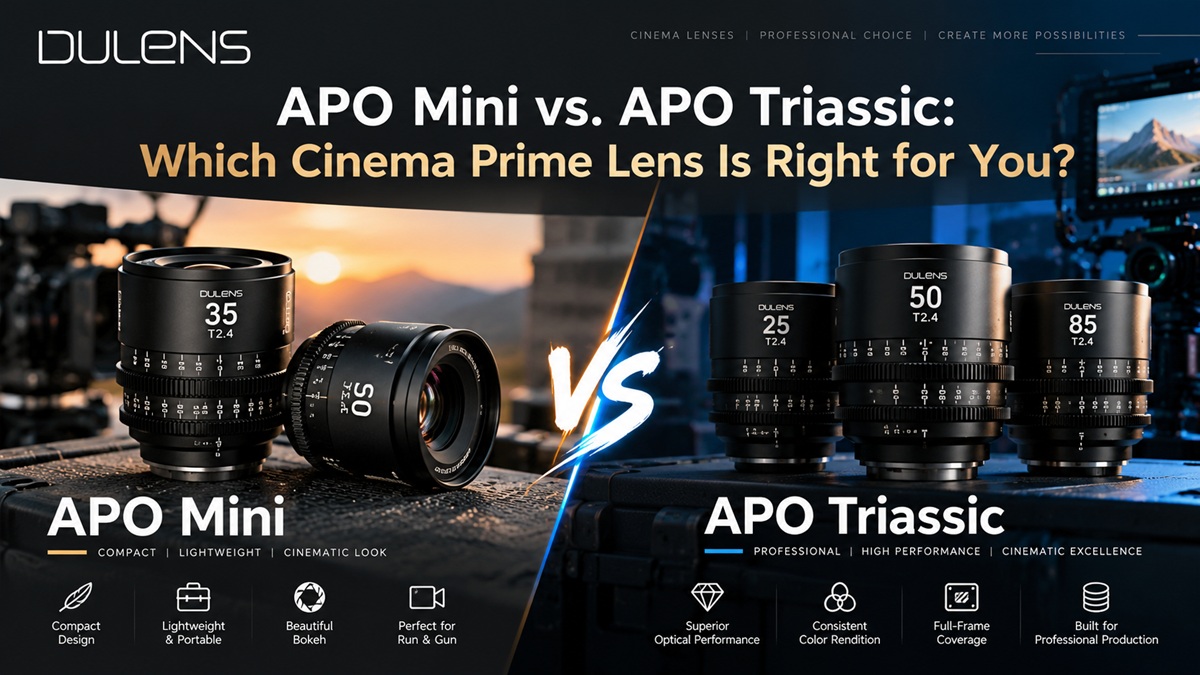
Two sets of lenses can have the same bokeh, the same color, and a similar setup, and yet perform very different tasks on set. That is the key difference between the Dulens APO Triassic and APO Mini.
When comparing two sets of lenses from the same company, it is simple to believe that one set is just the improved lens set. That is not the case here. There are different types of sets, each with its own appearance and advantages.
The APO Mini will provide you with a soft and warm look with an old-school feel. The APO Triassic looks cleaner and more crisp while also giving you a true close-focus range. If you choose incorrectly, the price can exceed the lens’s cost. You might require additional diopters, more time on the grade, or be in the end purchasing another set later.
This guide compares the APO Mini and APO Triassic in plain language. We will look at how each set looks, how it handles on set, and where each one fits best. At the end, you’ll know which set is best suited for your crew, camera, and what you want to shoot.
At a Glance: APO Mini vs. APO Triassic
| Feature | Dulens APO Mini | Dulens APO Triassic |
| Primary character | Vintage-inspired | Modern and high-resolution |
| Focal lengths | 21, 31, 43, 58, 85, 110mm | 25, 35, 50, 90, 120mma |
| Maximum aperture | Around T2.4, depending on focal length | T2.8 |
| Mount | PL and EF options | PL |
| Coverage | Full-frame / 46mm image circle | Full-frame / 46.5mm image circle |
| Front diameter | 80mm | 80mm |
| Filter thread | 72mm | 72mm |
| Focus system | Manual, 0.8 MOD gears | Manual, 0.8 MOD gears |
| Key strength | Character and compact operation | Resolution and close focus |
What Makes a Vintage APO Cine Prime Different?
Before comparing the two series, it helps to understand what the APO label means.
APO is an acronym for apochromatic. It is a lens design that focuses several colors of light at one point. This will help minimize color fringing even at wide apertures. Older vintage lenses can show purple or green edges around bright objects. A vintage APO cine prime keeps some of that classic look while cutting down on this unwanted color fringing.
Both series follow the same optical idea and cover large-format sensors. They also share an 80 mm front diameter and a 72 mm filter thread. The key difference is how each set renders an image and how close you can focus. These two points will matter most when choosing between them. That is why we will look at both in more detail in the sections ahead.
APO Mini Primes: Soft Skin Tones and Gentle Flare
The APO Mini is the more classic vintage cine prime of the two. Dulens uses a V+ coating to give skin a smooth look and a soft feel. It can also create a rainbow flare that adds some style to the frame. If you want less flare, stop the lens down by one or two stops.
The set has six focal lengths: 21, 31, 43, 58, 85, and 110 mm. Most lenses open to T2.4, while the 21mm opens to T2.6. Each lens weighs a little over one pound, which makes the set easy to use on gimbals and drones.
The main trade-off is the longer minimum focus distance. For true macro shots, you may need extra tools. Still, the APO Mini is a good fit for beauty work, music videos, and narrative projects where a soft vintage look is the goal.
APO Triassic Primes: Clean Contrast and Close Focus
The APO Triassic takes the Dulens look in a more modern direction. Compared with the APO Mini, it gives you more contrast while keeping skin tones and texture natural.
The set includes five focal lengths: 25, 35, 50, 90, and 120mm. All five lenses have a maximum aperture of T2. 8. The full set also comes in a shock-resistant hard case, which helps when the lenses need to travel between locations.
Close focus is one of the biggest differences with the Triassic. The 35mm focuses as close as 7.5 inches, while the 50mm can focus down to 9.4 inches. The 120 mm focuses as close as about 32.7 inches.
This makes the set useful for product shots, detail shots, and close portraits. No diopter or other close-up filter needs to be used to move in closer. The Triassic is compatible with the same matte box and filters as the APO Mini and does not require a change of filter setup when switching between the two sets.
Image Character: Vintage Expression or Clean Precision?
This is where the two lens sets feel most different.
The Mini gets its look from the glass. Its softer contrast and flare give the image a warm, old-school feel (Dulens). It can add a bit of mood without making the shot feel too styled.
The Triassic takes a cleaner path. It is made for high detail, strong contrast, and low color fringing (Dulens). The result is a sharper and more controlled image.
So, there is no clear winner. It comes down to the look you want.
For a product shoot, the Triassic may be the better fit when you need crisp edges and clean highlights. The Mini might be a better option used for a fashion film if you need more soft skin, halation, and flare.
The most important decision is which fits the job, rather than the lens spec.
Close Focus and Subject Detail
Close focus can make a big difference on some shoots.
The Triassic was built with close focus in mind. Its floating lens design helps it stay sharp through the focus range (Dulens). The 25 mm focuses as close as about 0.20 m, while the 35 mm gets to about 0.19 m (Dulens).
That extra reach is useful for tight product shots, small details, and frames where the subject sits close to the lens.
The Mini works well for most day-to-day film and commercial work. But when close-up detail is a key part of the shot, the Triassic has the edge.
Which Lens Series Fits Your Production?
The answer will depend on what you require from the lens.
Choose the APO Mini when the look matters most. Vintage is a great style for film, fashion, music videos, docs, and brand work.
Choose the APO Triassic when you need a clean, sharp image. It’s also high in detail, close in focus, which makes it a great choice for ads, product shoots, cars, and other shots that require a lot of smaller details.
Choose both when you need more range. The two sets cover different creative needs and can work well as part of a larger kit (Gafpa Gear). This can be beneficial for rental homes and production groups looking for additional choices.
The Mini adds character. The Triassic gives you a clean, detail-rich look.
Conclusion
The APO Mini and APO Triassic are not direct replacements for each other. They are built for different kinds of shoots.
The mini is a good choice if you want a clear vintage cinema look. Its small body, expressive flare, and wider range of focal lengths make it easy to use across different types of work.
The Triassic makes more sense when close focus, higher contrast, and fine detail matter most. Its focal lengths also give you options that the Mini does not cover.
For production companies, rental houses, and cinematographers, the right choice comes down to the job. Look at your camera sensor, the focal lengths you use most, how close you need to get
Are you ready to build your vintage APO cine prime kit this season? Contact Dulens Optical today for specs, mount options, and a custom lens plan.
FAQs
What does “APO” mean in a cinema lens?
APO means apochromatic. It refers to a lens design that brings several colors to the same focus point. This helps reduce color fringing, even when shooting at wide apertures.
Are vintage lenses good for cinema?
Yes. They can be a good choice when you want softer contrast, gentle flare, and natural-looking skin tones. APO designs can keep some of that vintage feel while giving you cleaner color and better control.
Can I mix APO Mini and APO Triassic lenses?
Yes. The two sets share similar color, bokeh, and gear positions, which makes it easier to use them in the same kit.
Is the APO Triassic a vintage lens?
Not quite. It shares some of the Mini’s bokeh and color traits, but its image is more modern. It gives you higher contrast, more detail, and a cleaner overall look.
Which prime is best for extreme close-up shots?
The APO Triassic 35mm is a strong choice for tight shots. It can focus as close as about 7.5 inches, making it useful for close detail and product work.