
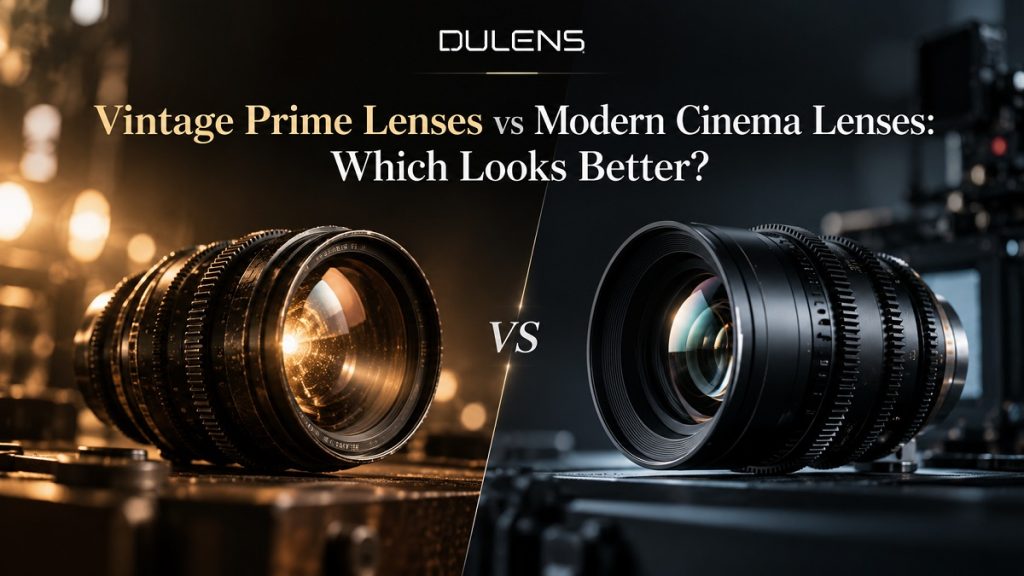
Vintage Cinema Lenses can alter a scene before lighting and grading sets in. The distinction is clear when a state-of-the-art digital sensor documents it all. Productions have different requirements: some require clinical clarity; others, texture and personality. This is why Vintage Cinema Lenses are still in use today in commercial and narrative filmmaking. Older optics can reduce contrast, adjust the shape of highlights, and provide unique rendering of background elements. In most instances, modern movie lenses provide a clearer picture, enhanced stability, and workflow convenience.
None of these is necessarily the better option for all projects. This choice will vary depending on the story, format, lighting, production schedule and desired finish. Reliability, matching, servicing, and budget are also a part of the decision for production teams. It also provides a breakdown of where each type of lens is useful in professional production. The right optical choice can impact the mood, consistency, finishing time, and production confidence for every production team.
What Actually Makes a Lens Look Vintage?
The vintage look does not necessarily depend on the age of the lens. Rendering is affected by optical design, glass, coatings, mechanical condition and servicing. Vintage Cinema Lenses tend to retain more visible optical properties than modern lenses. These qualities can create a vintage lens style with less sharpness, flares, edge falloff, and weird bokeh characteristics.
Not all older lenses will give you a soft or romantic look, though.
ZEISS notes that some older Super Speed lenses were extremely sharp when stopped down. Not all older lenses are “”soft” — each one will have a different look. According to Cooke, these vintage pieces of speed Pancro are painterly, cinematic, and less clinically sharp.
Vintage Cinema Lenses: What Do They Add?
Vintage Cinema Lenses are commonly chosen when the vintage lens aesthetic has become a part of the image. Older coatings may allow more flare, veiling glare, and/or reduced contrast around bright sources. These effects can be used to create an atmosphere without extra filtration while capturing. Older optical designs can also give rise to unique focus fall-off at the edges of the frame. Bokeh can appear more natural and have more noticeable shapes and smooth background transitions.
Incidentally, different lens families can have different color rendering, particularly over older lenses. The variation can make a personality, but it can make matching focal lengths a challenge. Before a crucial commercial shoot, vintage cinema lenses must be thoroughly tested. It is recommended that a cinematographer should test the whole set of vintage cinema lenses rather than just a single focal length. Additionally, condition is important since age may have an impact on the mechanics, coatings, and optical uniformity. The two challenges ZEISS has mentioned are reliability and matching.
Modern Cinema Lenses: Where Do They Win?
Modern cinema lenses focus on consistent results, improved optical control and reliable performance. They are typically used in current sensors and in high-tech digital applications. Modern cinematography lenses usually offer matched color, consistent coverage and predictable focus behavior. Manufacturers also create standardized mechanics for quicker lens changes with current sets.
ZEISS Supreme Primes are consistent in color, coverage, size and ergonomics throughout the range. ARRI Signature lenses provide warm skin tones and controllable focus behavior with high detail. These properties are relevant in productions with multiple cameras, operators and shooting locations. ZEISS Supreme Prime Radiance lenses help to produce controlled flares while keeping contrast and transmission high. This demonstrates the ways in which existing optical design can re-create specific vintage features more efficiently.
Vintage Lenses vs Modern Lenses: The Visual Difference
The simplest comparison is to examine image characteristics on an individual basis. Both of these types of lenses can perform very well; however, they have distinct advantages.
| Image factor | Vintage Cinema Lenses | Modern cinema lenses |
| Sharpness | Often softer or more varied | Usually high and consistent |
| Contrast | Can be lower or less predictable | Generally controlled and repeatable |
| Flare | More organic and unpredictable | Usually minimized or deliberately controlled |
| Bokeh | Often distinctive or irregular | Usually smoother and more consistent |
| Skin rendering | Can appear gentle and characterful | Usually clean with controlled tonal detail |
| Focus behavior | May show breathing or edge shifts | Usually more stable and predictable |
| Matching | Can vary across focal lengths | Usually closely color-matched |
| Reliability | Depends heavily on the condition. | Designed for demanding professional use |
The table demonstrates the importance of visual preference to production requirements. A romantic image may benefit from optical variation and gentle imperfections. If a project has a lot of VFX, it might require a consistent distortion, flare, focus, and color behavior. In general, modern cinema lenses will make those requirements easy to manage in complex shoots.
Which Looks Better for Commercial Production?
For commercials, product films, and branded content, the best lens choice comes down to the look you want to achieve. Luxury campaigns can work well with controlled softness and smooth highlight rendering. Beauty projects often benefit from flattering skin tones without losing the detail needed during finishing. Vintage Cinema Lenses can create a distinct vintage look directly in the footage. However, too much flare can be a problem when products need to look clean and precise. Modern cinema lenses are often a better fit when multiple setups need to match consistently. They also make production easier when there is little time to test different lenses between setups.
When Should You Choose Vintage Glass?
Choose Vintage Cinema Lenses when you want the lens itself to have a noticeable influence on the image. They can work particularly well for period films, music videos, fashion films, and dramatic projects where a clean, modern image is not the goal.
They can also add a vintage feel to footage shot on digital cameras, especially when the lighting is carefully controlled. But testing is important. Vintage lenses can behave very differently from one another, even when they come from the same era or lens family.
Before a shoot, check how the lenses handle flare, contrast, skin tones, focus breathing, and the edges of the frame. It is also worth checking how well the set matches from one focal length to another. Sensor coverage needs attention too. Some older lenses simply do not cover larger sensors properly.
Rehousing can help if the original lens mechanics are difficult to work with on a modern production. It can make the lenses easier to pull focus with, mount, and use on set without taking away the optical qualities that make Vintage Cinema Lenses appealing in the first place.
When Are Modern Cinema Lenses the Better Choice?
Modern cinema lenses are a better fit when the shoot needs consistency and control from one setup to the next. They are particularly useful for VFX work, multi-camera productions, commercials, and tight location shoots where there is little room for surprises.
That does not mean modern lenses have to look clinical. Some newer lens sets are designed to add character while still keeping their optical and mechanical performance predictable. ARRI Signature Primes, for example, combine high resolution with warm rendering and smooth bokeh. Leitz HUGO lenses take the optical character associated with Leica M lenses and pair it with cinema-focused mechanics.
Many lens manufacturers now build their ranges around specific visual styles as well as practical production requirements. This gives filmmakers more room to choose a particular look without giving up the reliability needed on a professional set.
A Better Buying Approach for Production Teams
Production buyers should not choose a lens set just by looking at the specs. A proper camera test will usually tell you much more about how the lenses will actually behave on set.
First, decide what you want the image to look like. Once that is clear, narrow down the lens families that fit the project and test them under the same conditions. Keep the lighting, exposure, camera settings, and grading consistent so the differences between lenses are easy to see.
It also helps to test skin tones, practical lights, backlighting, close focus, and wide-open shooting. Look at the whole set, not just one focal length. You want to know whether the lenses feel like they belong together when the focal length changes.
For commercial productions, practical details matter too. Check servicing support, spare parts, rental availability, and delivery times before making the final decision. Dulens Optical can help production teams compare optical options based on the actual needs of a shoot.
In the end, a hands-on test can show things that a specification sheet simply cannot.
Conclusion
The decision over vintage and modern lenses typically depends on one factor: character vs. control. Vintage Cinema Lenses can add texture and a visual “feel” to digital footage. Meanwhile, modern cinema lenses can provide a cleaner shot and retain plenty of character. Neither type will automatically create a cinematic image. Lighting, composition, exposure and grading still have a significant impact.
In commercial productions, consistency and reliability are equally important, especially when it comes to creative preferences. When you’re not sure which lens or lenses best suit your project, Dulens Optical can be useful in helping you select the right one(s) for your project.
Contact Dulens Optical today to discuss the right lens solution for your next production.
FAQs
Are vintage lenses better than modern cinema lenses?
Not necessarily. Vintage lenses have more individual and optical flaws, while modern cinema lenses are extra regular, controllable, and reliable.
Why do cinematographers use vintage cinema lenses?
They select vintage cinema lenses for their softer contrast, flare, weird bokeh and non-clinical digital appearance.
Do vintage lenses work with modern digital cameras?
Yes, however, it will depend on the mounting, sensor coverage, flange distance, and mechanical fit.
Is it possible to achieve an old look with modern lenses?
Yes, there are some existing cinema lenses that have a vintage look while being controlled and working mechanically with modern lenses.