
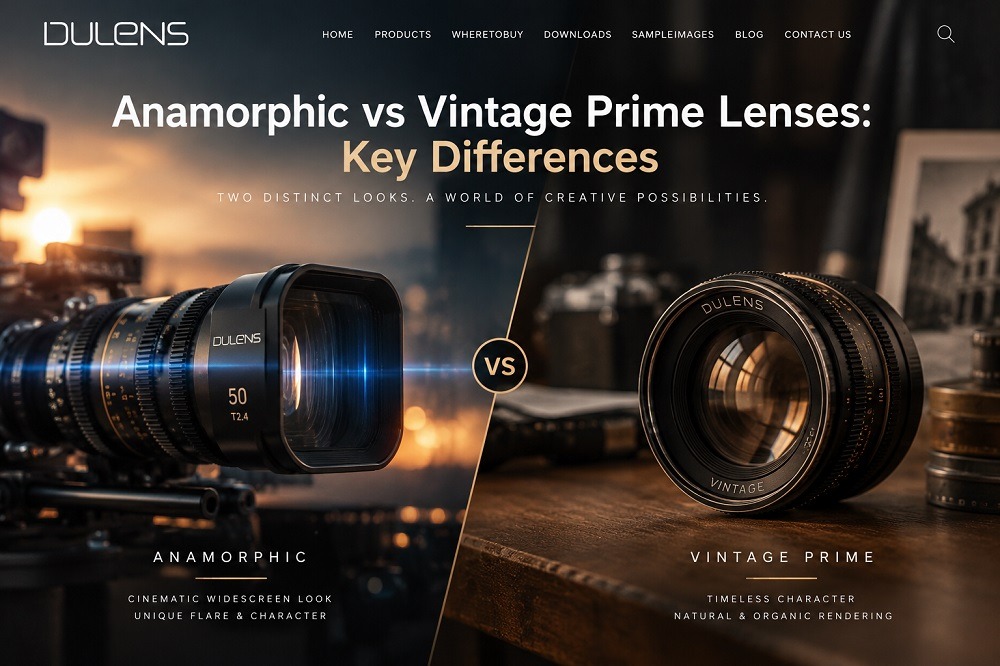
Choosing a cinema lens is about more than finding an attractive image style. The lens affects framing, optical performance, workflow, and consistency on set. These factors matter for cinematographers, production companies, rental houses, and commercial filmmakers alike. Together, they determine how much control a team has over the final image. This is why the difference between anamorphic and vintage prime lenses matters when a project needs a specific visual character rather than a purely sharp image.
Modern digital cameras can produce extremely clean and detailed images. As a result, lenses have become an important creative tool for adding character. Anamorphic and vintage prime lenses can both create distinctive images, but they do so in different ways.
Anamorphic lenses change the geometry of the image. Vintage prime lenses mainly influence how the image is rendered through contrast, sharpness, flare, focus fall-off, and other optical characteristics. Understanding this difference can help production teams choose the right lens for the creative brief, camera system, and post-production workflow.
What Makes Anamorphic Lenses Different?
Anamorphic lenses squeeze the image horizontally during the capturing process. The recorded image is then de-squeezed in post-production or through the camera/viewfinder so subjects appear proportionally correct. According to ARRI, these new anamorphic systems are “high-end cinema optics crafted to work side-by-side with anamorphic imaging.”
The result is more than just a wider frame. The classic 2x anamorphic designs can give rise to a distinct oval bokeh, horizontal flare, and elongated sense of space. According to ZEISS, 2x anamorphic geometry increases the perceived sense of depth, scale, and presence. Modern designs allow more precise control over this effect.
Common characteristics include:
- A mandatory de-squeeze process and horizontal compression
- Oval or elongated out-of-focus highlights
- Horizontal light streaks or unique flares
- Wider framing without simply using a shorter spherical focal length
- Possible distortion, unusual focus fall-off, or edge softness depending on the design
- A clear visual pattern throughout a production
These effects vary from lens to lens, and not all anamorphic lenses create such effects. Noticeable differences can be observed with squeeze ratios of 1.3x, 1.5x, and 2x. Modern designs can also minimize unwanted distortions or flare when more optical control is needed.
What Defines a Vintage Prime Lens?
Vintage prime lenses are fixed focal length lenses made with an older optical design. It can also be a newer lens designed to mimic the look of classic film or photographic lenses. “Vintage” is not necessarily an old lens on an old camera system; it can also be a new lens designed to produce a vintage look.
The differences between anamorphic and vintage prime lenses become more noticeable when you take a look at rendering. Vintage-style optics are frequently different in contrast, sharpness, flare, color, focus transitions, distortion, and out-of-focus areas. The report from CineD on vintage Soviet optics demonstrates how the older designs can create a very different look that modern cinematographers are still finding.
Today’s manufacturers can also design vintage-style cinema lenses, not just rehouse or recoat old glass. For example, Dulens states its APO Mini Prime has a special coating system that ensures it brings back the “vintage effect” while maintaining a controlled cinema-lens design.
Vintage Prime Lens Character: What Actually Creates the Look?
The look of a vintage top lens really comes from a bunch of optical properties working together rather than any softness by itself. Contrast, sharpness, flare, color rendering, distortion, and how the scene image transitions from attention to out-of-focus zones can all play a part in the final result.
Contrast is one of the main differences. Some vintage designs let you go a bit lower on the contrast, so the virtual photos end up looking gentler and far less clinical. Flare can also be more obvious, especially when you shoot near solid light parts. Depending on the lens and coatings, it might show up as veiling flare, ghosting, or even a shift in usual contrast.
Sharpness can also vary throughout the body and with the diaphragm. Some vintage lenses prove to be softer when used wide open, while others maintain strong center sharpness with greater dropout closer to the edges. Additionally, focus transitions and history display can contribute to the character in the photo.
These traits are not necessarily flaws. For many cinematographers, they are exactly what makes antique optics useful for creating an extra-specific image. Modern antique-inspired cinema lenses can also replicate certain features while providing additional stable mechanics and performance for expert production.
Anamorphic vs Vintage Prime Lenses: Key Differences
The difference between anamorphic and vintage prime lenses is the way they impart character to images. Anamorphic lenses compress the image horizontally, whereas vintage prime lenses primarily influence the image rendering with contrast, sharpness, flare, color, and the way the image focuses.
Sometimes anamorphic lenses can create oval bokeh, horizontal flares and a broader horizontal field of view following the re-squeezing process. Vintage primes are typically spherical and have a wider range of optical qualities.
| Factor | Anamorphic Lenses | Vintage Prime Lenses |
| Image geometry | Squeeze the image horizontally and stretch it back during de-squeezing | Provide a mostly natural, spherical picture. |
| Bokeh | Often give the background a more oval-shaped bokeh | Depending on the lens, the rendering may be soft and smooth or more unusual. |
| Flare | Can create the familiar horizontal or directional flares | Contrast and flare can vary significantly from lens to lens |
| Field of view | After de-squeezing, provide you with a wider-looking frame. | Maintain the standard focal length of the field of view |
| Overall look | Add a more apparent widescreen quality. | Provide softer contrast and a more vintage look |
| Workflow | Usually need de-squeeze monitoring while shooting | Easy to shoot with and monitor |
| Lens matching | With a matched set, the same look is maintained from one focal length to the next. | Different focal lengths may have slightly different looks |
| Common use | It’s a common technique used in widescreen movies, commercials, and projects. | Ideal for vintage-themed movies, commercials, music videos, and more |
The main difference comes down to the kind of image you want. Anamorphic lenses give you the wider frame, oval bokeh, and horizontal flare that many filmmakers look for. Vintage primes are more about the character of the glass. Their contrast, sharpness, flare, and focus can change quite a bit from one lens to another.
Which Lens Type Is Better for Professional Production?
While choosing either anamorphic or vintage prime lenses, you must focus on both the stylistic element and the technical one. In addition, the production process becomes more complicated when using anamorphic optics, whereas vintage primes easily integrate into a spherical pipeline.
For professional productions, consider:
- Sensor coverage and mount compatibility
- Consistency across focal lengths
- Focus breathing and close-focus performance
- Flare, contrast, and skin-tone rendering
- Mechanical reliability and service support.
- Availability for rental or replacement
When Should You Choose Vintage Cinema Lenses?
Anamorphic lenses might be a better fit if the production requires a “widescreen” impression, an oval bokeh, and an identifiable anamorphic flare. Vintage cinema lenses are more appropriate if the desired look is an organic image rather than one with anamorphic geometry.
The vintage-inspired modern lenses can also offer this same character with more uniform mechanics and optical performance. Dulens makes cinema prime lenses that are designed to achieve both a vintage look and professional-grade reliability.
How Should Production Teams Make the Final Choice?
Most often, the best way to compare lenses is a side-by-side camera test. Compare and contrast the results for flare, sharpness, focus transitions, skin tones, and contrast using the same camera, light, exposure time, subject, and f-stop.
When choosing a lens for a commercial or narrative project, you should select the lens that best suits the desired image character, not just the one with the strongest technical specs. It’s the one that delivers the desired look consistently throughout the production.
Final remarks
Anamorphic and vintage prime lenses offer contrasting characteristics to the image. Anamorphic lenses are recognized for the compressed picture, broader frame, oval bokeh, and horizontal flares. Vintage glasses are more about the glass itself. The final look of an image can vary with contrast, color, sharpness, flare, and focus response.
The better choice depends on the production. The camera, shooting conditions, workflow, and the look you are after all need to be considered before choosing a lens set.
Dulens Optical provides a range of cinema primes available for vintage-style renderings with modern cinema mechanics.
FAQs
Do vintage lenses look more cinematic?
They can. Older or vintage-inspired optics can offer softer contrast, unique flare, and character that highly corrected modern optics lack.
Are anamorphic lenses better than vintage lenses?
No. Each is designed for different purposes. Anamorphic lenses offer some unique geometry and widescreen qualities, while vintage primes are more about optical rendition.
What is the main advantage of anamorphic lenses?
They provide a distinctive widescreen image with characteristics such as oval bokeh and horizontal flare, depending on the lens design.
Can a vintage prime lens look like an anamorphic lens?
Even some vintage primes can have similar flare/bokeh qualities, but their flare/bokeh doesn’t reproduce anamorphic image geometry without further optical manipulation or processing.