
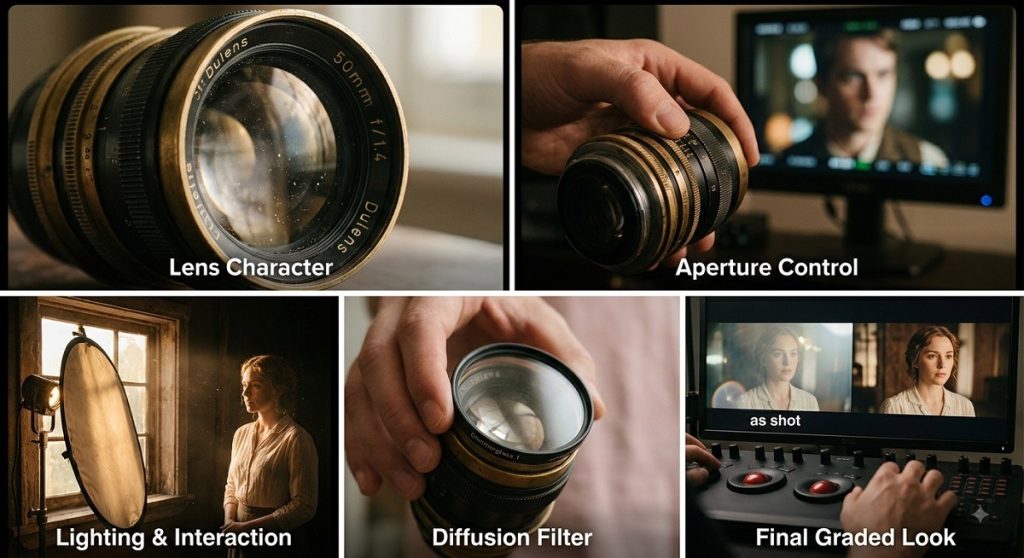
A cinematographer friend once sent me two clips of the angle of equal length, shot a few minutes apart with the identical digital camera. One gave the look of stock footage. The other was like a scene from a movie you’ll remember for years. Same light, same actor, different lens. The most useful distinction is the glass in front of the sensor.
That’s the maxim that filmmakers and colorists figure out: that sharpness doesn’t equal cinematic quality and that the look of the antique film lens isn’t a filter or a trend. It’s an optical choice that will affect the viewer’s perception of the footage before the first spoken word is said. This guide breaks down what exactly creates that look, why production houses go after it, and how to reliably achieve it on a realistic budget and schedule.
What Creates a Vintage Cinema Lens Look?
The Vintage Cinema Lens Look comes from several optical properties working together. A managed Vintage Cinema Lens Look starts with optical behavior, not a suggested software program. Older designs were generally not corrected to the same degree as many current optics, producing more visible flare, less equalization, softer edges, field curvature, or shadow shifts. To evaluate the Vintage Cinema Lens Look, look beyond sharpness.
A lens can preserve facial detail even when it generates softer transitions. Cooke describes the conventional Panchro rendering as painterly and cinematic, with the focus/sharpness falling off toward the edges wide open.
| Optical trait | What it can contribute |
| Lower contrast | Softer tonal separation |
| Flare | Visible response to bright sources |
| Gentle focus fall-off | Softer edge transitions |
| Characterful bokeh | Distinctive out-of-focus areas |
| Color rendering | Warmth or subtle color personality |
| Controlled softness | Less harsh detail without losing definition |
1. Start With the Right Lens Character
There isn’t a single “vintage” lens formula, and vintage cinema lenses aren’t the same. Different images can be generated by Cooke Speed Panchros, Super Baltars, Canon K-35s, Zeiss Standard Speeds, and even modern vintage-style designs. Variations can occur even from lenses in the same family of lenses due to age, maintenance, coatings, and lens use. Cooke specifies that the original Speed Panchros can vary over the years.
Test the actual lens set. Examine the capability of each lens for skin tones, flare, sharpness, edges, focus breathing, and focal-length consistency.
Inconsistency in vintage cinema lenses can make modern vintage-style lenses a practical alternative. According to Dulens, its APO Mini Prime series is coated to reduce contrast, soften skin tones, and produce halation and rainbow flare without compromising its apochromatic optical design.
2. Use Aperture to Control the Effect
A lens’s rendering changes dramatically at different aperture sizes. Depending on the design, opening the iris will increase background separation, softness, or flare. Stopping down helps restore contrast and reduce optical artifacts.
Dulens claims that its APO Mini lenses generate more pronounced rainbow flare at F1.6 and can also be stopped down to minimize flare. To achieve a Vintage Cinema Lens Look, try both wide open and stopped-down. Aperture depends on lighting, distance, focal length, and required character.
3. Build the Look With Lighting
The lens character turns out to be simpler to see when the lights provide the optics with something to respond to. Backlighting, practical lights, windows, and reflectors can trigger the flare and highlight behavior that reveals a lens’s character.
Control the interaction with light. If there’s too much flare that may block the face or create continuity issues, try out the lighting with the lens.
This style is better suited to soft, well-curved illumination, which is typically done with the lens, rather than with weaker lighting.
4. Add Diffusion Carefully
A diffusion filter can be used to add some softness and highlight bloom, but not to the detriment of a proper lens. Research into the ProMist-like diffusion process explains the phenomenon of soft halation, loss of contrast, and highlight diffusion.
Use the weakest filtration that produces the desired effect. Diffusion can be intensive and may diminish the facial detail and make product or beauty work more difficult to grade. A strong filter may overpower the image if the lens has an inherent strong flare or softness.
5. Match the Lens to the Production
The best vintage cinema lens depends on the type of production and the look you’re trying to achieve. Depending on the scene, it may require more powerful flares and less contrast to create that image, or it may require a cleaner and more controlled image for product photography, interviews or commercial work.
Consider:
- Sensor format and image-circle coverage
- Mount compatibility and adapter requirements
- Maintaining the same focal length for the entire lens set.
- Focus throw and gear compatibility
- Close-focus performance
- Flare and contrast with your planned lighting
- Rental, service, and replacement options
Rehousing can also matter for professional-grade units. Vintage optics may also want mechanical safety, standardized gears, and reliable operation for demanding workflows. B&H notes that vintage cinema lenses are prized for how they render skin tones, texture, and flare, while modern remakes aim to offer similar character with more reliable, serviceable mechanics.
Vintage Cinema Lens Look vs. Digital Post-Processing
Post-production can add grain, soften contrast, reduce sharpness and impart highlight effects, but lens behavior starts at capturing. Perfectly reproducing optical flare, focus fall-off, field curvature, and out-of-focus rendering is challenging to reproduce after the shot.
The process follows a logical sequence: lens selection, lighting, filtration, exposure, and grading. A vintage cinema lens look is captured by the camera, then color grading takes over to refine it. It also helps maintain consistency as editors aren’t required to create everything in postproduction.
Why Modern Vintage-Style Lenses Matter for Commercial Production
A perfect Vintage Cinema Lens Look can be re-used to create a brand and commercial campaign visual signature.
Authentic antique optics can be expensive, inconsistent, difficult to maintain, or limited by their original mechanics. Also, vintage cinema lenses vary by condition. Modern vintage lenses can overcome some of these issues by combining older rendering standards with current mounts, mechanics, and optical consistency.
Dulens APO Mini primes are among the modern alternatives to vintage cinema lenses and come in PL and EF mounts and cover full-frame sensors, even as the manufacturer emphasizes stable color, vintage-oriented coating, and cinema-focused features.
How to Get the Vintage Cinema Lens Look: A Practical Workflow
You don’t need to use a “vintage” lens to achieve a vintage look. The first step is to determine what kind of image you would like, then look for a lens that can produce it.
Here’s a simple workflow to follow:
- Outline the desired look: Do you want softer images, warmer colors, lower contrast, more flares, or a more natural, organic look?
- Test different lenses: Try a few vintage-style lenses at the focal lengths you plan to use.
- Shoot real-world subjects: Test skin tones, bright highlights, practical lights and detailed objects to see how each lens performs.
- Test different apertures: Compare the lens wide open and stopped down. Most lenses will adjust slightly as you zoom in and out.
- Use your actual camera setup: Test the lenses with the camera, lighting, and other equipment you will use during the production.
- Don’t forget to add diffusion as necessary: If the character you are looking for is already achieved by the lens you are using, you might not need a diffusion filter. Use one only in instances where additional softness is desired around highlights.
- Build a matching grade: Don’t overlook or attempt to create a totally different color grade in post-production.
- Keep your settings consistent: Record the lens, aperture, exposure, and other important settings so you can maintain a consistent look across different shooting days.
Conclusion
The vintage cinema lens look is most effective when used as a tool for creativity and not merely a preset.
Using a good vintage-style lens can enhance the background with softer transitions, wonderful flares, gentle contrast and more character. At the same time, it can still deliver the image quality and reliability needed for modern digital cinema cameras.
Dulens Optical’s vintage cinema lenses are designed specifically for cinematographers, rental houses, production companies, and commercial filmmakers to produce this kind of image. The APO Mini series is a collection of vintage-inspired optical characters with modern cinema mounts and a purpose-built lens design.
Looking for a more unique cinematic look for your next project, check out Dulens Optical’s vintage cinema lenses and discover which optical look is right for you.
Frequently Asked Questions
How do you know if a lens is vintage?
An older-style character may be achieved by using lower contrast, specific flare, soft edges, focus fall-off, and unconventional bokeh. This is dependent on design and aperture.
What lenses give the most authentic vintage cinema lens look?
Older Soviet Helios primes, Canon FD glass and Leica R lenses are considered to be the ones that convey the most vintage look, especially in bokeh and flare.
Can vintage lenses be used for filmmaking?
Yes, if their optical and mechanical properties are appropriate for this production. Thorough testing is important because older lenses may not be in optimal condition or consistency.
Which focal length is ideal for a cinematic effect?
There is no one focal length. 35mm, 50mm or 85mm can work depending on sensor format, framing, subject distance and perspective.
Do vintage lenses work on modern cinema cameras?
Many do, but compatibility depends on mount, image-circle coverage, flange distance, and mechanical condition. Professional work may require rehousing or suitable adapters.